
Japan posters, from Mount Fuji to the pagodas of Tokyo
Japan in posters begins with Hokusai in the 18th century and continues through the travel posters of the 1960s. Mount Fuji, pagodas, cherry blossoms, torii. The guide to choosing and hanging them.

Key points
- 27 posters in the Japan posters collection, the 20 from this article in the table below.
- From CHF 16.00 in A4, up to CHF 55.00 in A0, 5 sizes for each poster.
- Printed in Europe on demand, free delivery from €59.
The table
The 20 posters at a glance

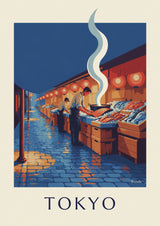


Japan is one of the few places where the poster existed before the invention of the Western poster. The ukiyo-e of Hokusai and Hiroshige were already, in the 18th century, images printed in series for home decoration. This tradition directly influenced Toulouse-Lautrec, Manet and European Art Nouveau. Here’s how to bring that lineage into your home.
3 Japanese moods come to life as posters. The eternal, stylized Mount Fuji in the manner of Hokusai, red wooden pagodas against a backdrop of cherry blossoms, and urban Tokyo between neon Shibuya and traditional Asakusa. Each one sets a different world.
Ideal placement: a single Japan poster per room, never 2 competing ones. Above a gray linen sofa, in a minimalist bedroom, or as a series of 3 small horizontal sizes in a hallway. Matte black lacquered frame or raw light wood. See our complete collection of Japan posters and Tokyo.
When the poster was invented in Japan, before the West
In the 18th century, while Europe was only beginning to print images in series, Japan was already producing them by the tens of thousands. The ukiyo-e (pictures of the floating world) by Hokusai, Hiroshige and Utamaro circulated like posters: you bought them cheaply, hung them up, and replaced them.
This graphic tradition, with its flat areas of color, bold framing and pure lines, directly influenced the Western Impressionists and Art Nouveau. Toulouse-Lautrec would not be Toulouse-Lautrec without Hiroshige.
A Japanese poster is therefore more than a travel souvenir: it is the direct ancestor of all modern posters. That is why it ages particularly well in a contemporary interior that favors clean lines and uncluttered compositions.
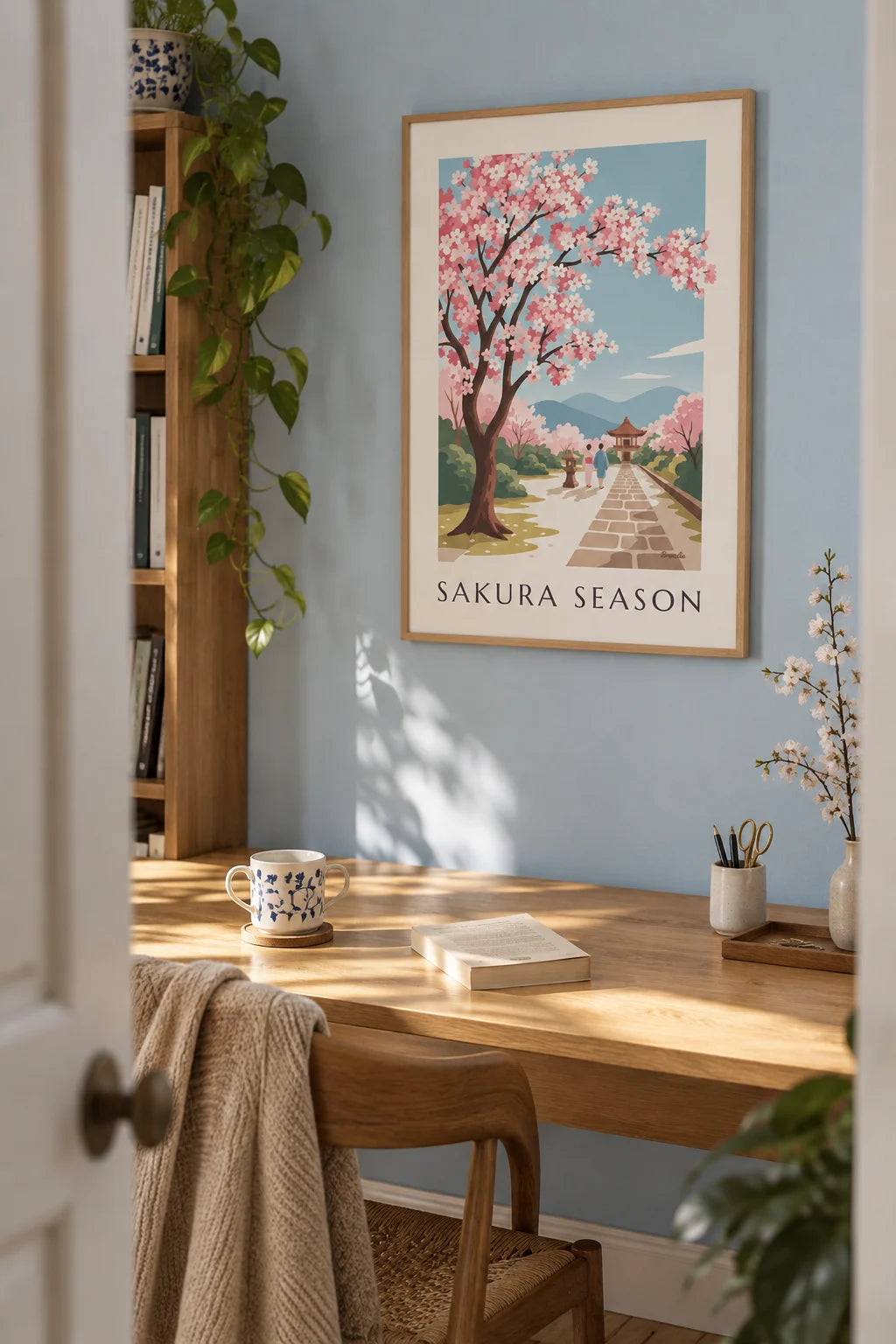


4 motifs that define Japan in poster form
Mount Fuji
A snow-capped summit, its base ringed with clouds, seen in every season (Hokusai made 36 views of it). It is the most universal motif, one that works in every type of interior. The Hokusai Fuji, restrained and geometric, fits into Scandinavian and industrial decor alike.
Pagodas and temples
The Golden Pavilion in Kyoto (Kinkaku-ji), the red pagoda of Sensō-ji in Tokyo, the orange torii gates. More narrative than Fuji, these motifs tell the story of a visit rather than a landscape. Lovely in a hallway or an office.
Cherry blossoms
Hanami, the contemplation of cherry blossoms, is a central motif in Japanese art. Pink branches on a pastel background, sometimes with a figure in a kimono or a torii. Ideal for a bedroom, thanks to its soft palette and contemplative subject.
Stylized waves
Hokusai’s Great Wave off Kanagawa (1831) is probably the most reproduced Asian image in the world. It opened up a whole genre of posters that play on the sea and the weather (storm, fog, snow). Very graphic, very striking.


3 ways to hang Japan on your walls
Zen minimalism
A single large poster, A1 or bigger, centered above a low piece of furniture. Light wood frame (oak or birch), wide cream mat. Simplicity is the very essence of traditional Japanese composition.
The seasonal triptych
3 Hokusai Mount Fuji prints, seen in 3 different seasons, hung side by side. A direct nod to the original print series. A3 or A4 depending on the wall.
Mixing eras
A Hokusai wave (19th century) next to a neon Tokyo poster (20th century), next to a contemporary torii. The common thread is the country, not the era. Worth trying if you want to capture the Japanese graphic world in all its depth.


The traditional Japanese palette
Pale pink of cherry blossoms, sage green of pines, pearl gray of mists, earth brown of temples, vermilion red of torii gates. A soft palette, apart from the red accent, that suits just about any light wall.


Build this wall
3 posters from this article, at true scale


All 3 posters: CHF 80.00
Frequently asked questions
You often ask us
Does vintage Japan really exist?
Yes. The ukiyo-e of Hokusai and Hiroshige (18th-19th centuries) are the direct ancestors of the modern poster, and they influenced Toulouse-Lautrec and Art Nouveau. Later, Japanese travel posters from the 1920s-1960s picked up their codes.
What are the classic Japanese motifs for a poster?
Mount Fuji in every season, pagodas, cherry blossoms, stylized waves (the Great Wave off Kanagawa), orange torii gates. Simple, readable motifs that are perfectly suited to hanging on a wall.
Do Japan posters work in a bedroom?
Very well. The traditional Japanese palette (pale pink, sage green, brown, pearl gray) is soothing. Choose contemplative posters (landscape, flower, bird) over neon urban scenes.
How do you pair a Japan poster with Scandinavian decor?
An obvious match: the 2 styles share minimalism, light wood and a neutral palette. An ukiyo-e poster in a light wood frame, on a white wall, with a Scandinavian armchair beneath it: the harmony is total.
Modern Tokyo or traditional Japan: which one to choose?
It’s a question of mood. Neon Tokyo (1980s style or reworked ukiyo-e) for a teen’s bedroom or a gaming corner. Traditional Japan for a living room, an adult bedroom, or a yoga or meditation space.
Keep exploring


